
Where Justice Dwells
March 10, 2026alumni
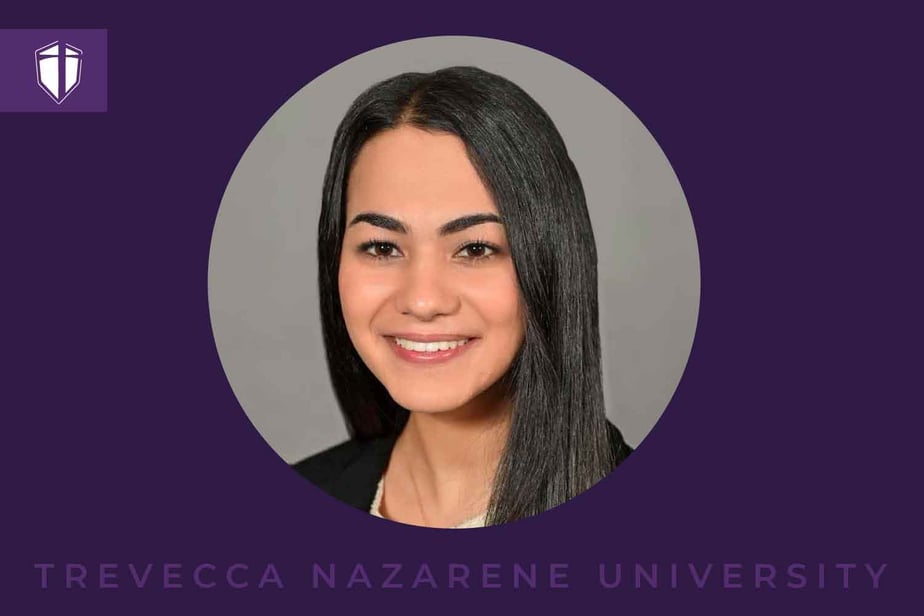
For Marina Yousef, her parents' determination and a long-shot chance to immigrate to the United States opened the door to opportunities she never expected.
Born in Egypt to a Christian family, Yousef’s parents worried about what the future might hold for their three daughters.
“My parents were well off in Egypt,” Yousef said. “But Egypt is not the friendliest place for women—specifically Christian women. So my dad and mom decided that if their children were going to have a good life, then they wanted to give us an opportunity to dream.”
The family put in their application for the Diversity Immigrant Visa Program, or “green card lottery,” and against unbelievable odds, they won. Yousef arrived in Tennessee as a seven-year-old, and grew up attending public schools with her parents encouraging her to find her calling along the way.
When she finished high school, Trevecca was a natural choice. It allowed her to stay local and was rooted in the beliefs her family had crossed an ocean to preserve.
“I had never visited Trevecca but I fell in love with it because it was a Christian university. So much of the reason my family came here was freedom of religion and freedom of expression,” Yousef said. “I visited other schools, but there is something different when you have a Christian mission, and I truly felt that.”
She threw herself into the many opportunities Trevecca presented, starting multiple clubs including a chapter of the Orthodox Christian Campus Ministries (OCCM). She also established the Pre-Law Club for students to explore legal careers and learn how to apply to law school. Eventually, she became student body president. She managed to fit in her leadership responsibilities around her classwork as she pursued a degree in history and public policy.
After four years of working for the good of the student body and building the educational prowess for legal work, Yousef graduated in 2020 and enrolled at Vanderbilt Law School.
She saw her future in the legal field as one centered around public interest work, where she could advocate for those seeking asylum and immigration help.
She also saw it as an extension of her faith, and an opportunity to mirror the character of God in her career.
“I feel like law is a place where Christians should be. First and foremost, because God is just and this is a profession where justice dwells,” Yousef said. “If you want a just system, you have to engage with it because as Christians we are called to administer justice faithfully.”
Initially, she found concrete places for her theology to flourish at Vanderbilt as she took on influential roles such as president of the Immigration Law Society, representative on the Equity, Inclusion and Diversity Council and more. She was actively working at clinics for refugees and immigrants in need of legal assistance, helping them secure asylum in the United States. But as an immigrant herself, and the daughter of immigrants, the work was heavy.
Yousef recalls the feeling of secondhand trauma, and seeing her mom and dad in each heartbreaking story of those seeking asylum. What she had always assumed was her calling was thrown into question as she wrestled with the pressure of helping those in need find the same freedom and opportunity she had been given so many years before.
“This was my pathway and my passion; I feel like every door in my life had opened to lead to this work. And yet I didn’t know if I could continue,” Yousef recalled.
She spoke with her public interest advisor, who empathized with her emotional exhaustion, sharing her experience as a person of color.
“There's a reason why I'm not in civil rights work. It’s just too close to home,” the advisor had said. “I think this is too close to home for you. You can do good work for the rest of your life in little ways, or you can continue pushing through the burnout and do this full time for two years and then never do this good work again.”
The freedom Yousef felt was incredible but it caught her off guard, forcing her to step beyond an identity and a resume she had built throughout the course of her life. As graduation loomed, her classmates studied for their law firm interviews, and Yousef, who didn’t quite know what was next for her, decided to go in without the formal preparation, even though the risk of graduating without a job could be steep.
“I didn’t prepare for the interviews. Law firms are competitive and you don't just casually interview. My classmates were studying and I decided I was not doing any of that,” Yousef said. “I thought, If they want me, they want me. I'm not going to say all the right things but I'm going to speak the truth and see what happens.”
And open the way he did.
At one specific law firm, she was bold in discussing her desires to continue using her legal skills to help immigrants even as she opened her career to other specialties. She was told by the interviewer firmly that they did not practice that type of law, and Yousef went away believing it would take a miracle for them to consider her.
But the themes of freedom and opportunity that had permeated her personal and academic journey prevailed, and that law firm called, “You’re our first call. We don’t do the work you want but we like your heart and we’ll let you do as much public interest work as you would like to do.”
Almost three years later, Yousef is doing just that. In addition to her day-to-day work at K & L Gates, in the firm’s Mergers and Acquisitions, Corporate and Healthcare and FDA practice groups, she continues to live out her calling, partnering with Nashville nonprofits to help immigrants and refugees secure the legal resources to change their futures on a volunteer basis. In 2025, she received the Attorney for Justice Award from the Tennessee Supreme Court, a recognition for the many hours of pro bono work she had completed for those organizations.
As she thinks about her dreams for the future, her long-term goal is to return to the Hill to work with students, providing guidance as they discover how their faith integrates with their future, especially in law.
When she reflects on her time at Trevecca and the ways in which she was prepared for her career and calling, the parable of the sower in the New Testament is the first thing that comes to mind.
“Seeds are thrown everywhere and either they sprout or they get choked, depending on the soil. Trevecca was that fertile soil for me because the community was safe but it wasn't a fake safety. My professors and mentors weren’t just saying what I wanted to hear; there was also pruning,” Yousef recalled. “There were advisors encouraging me and telling me that I'm capable of leading well, but they also pointed out what needed to be corrected and showed me how.”
As she continues forward using her experiences and expertise to bring justice and hope to her clients, she has carried one lesson through it all.
“I feel like that is my story: When nothing seems to make sense, God opens doors.”
